
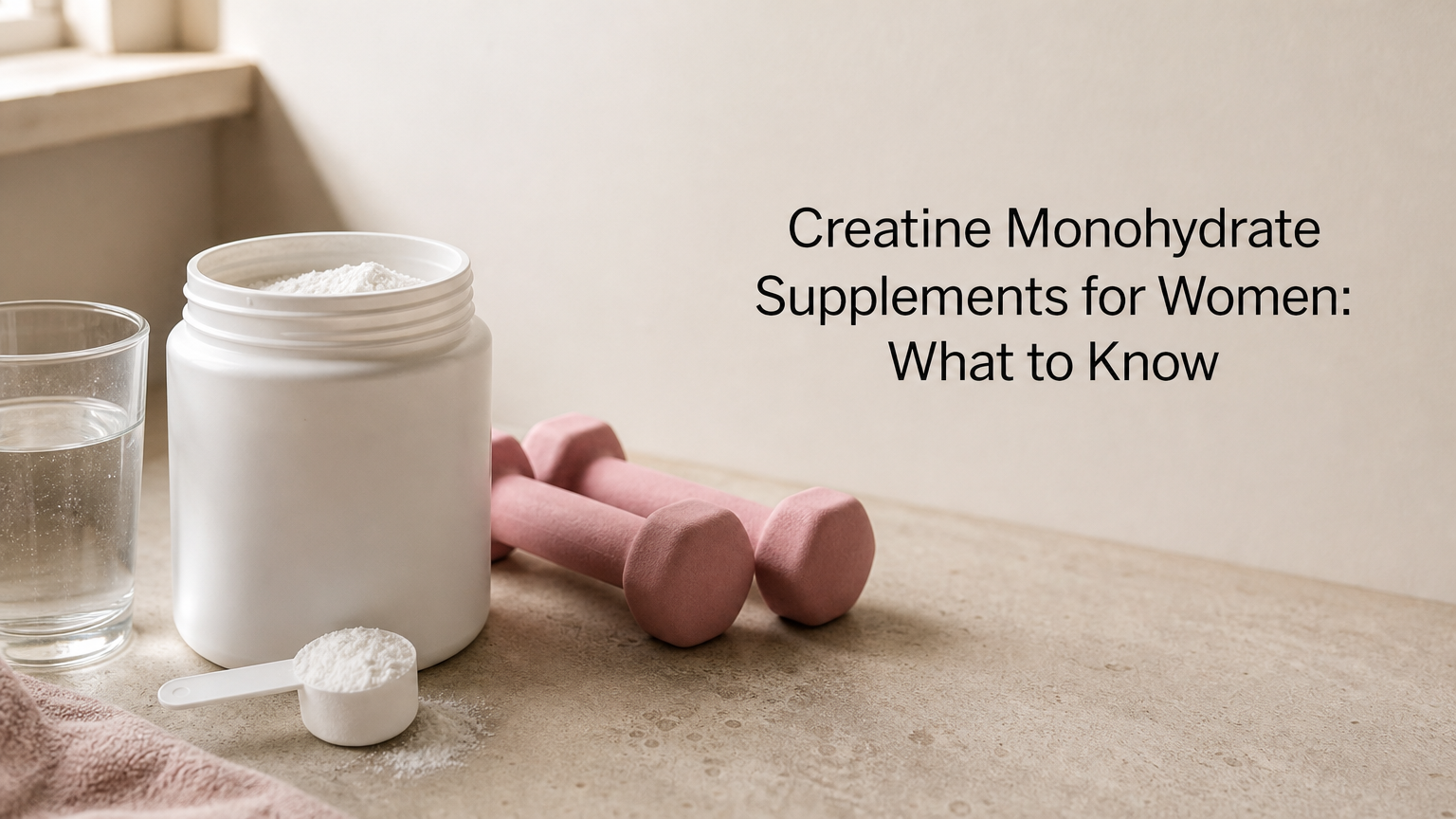
Creatine monohydrate supplements for women are safe and worthwhile for most healthy adult women at 3 to 5 grams a day, taken consistently and paired with strength training. The benefits are strongest for muscle, strength, and workout performance. The most common side effect is mild bloating, and the people who should check with a clinician first are women with kidney problems, women who are pregnant or breastfeeding, and women on certain medications.
Creatine is a compound your body makes from three amino acids (arginine, glycine, and methionine) and stores mostly in muscle. Your cells use it to recharge ATP, the energy molecule behind short, hard efforts like lifting a heavy weight or climbing stairs fast. Monohydrate is the form that sits behind nearly all the research. Other forms exist, but none has beaten it in studies.
This guide covers why creatine matters for women specifically, how to take it, what the real side effects are, and how to pick a clean powder or capsule without paying extra for pink packaging. We also cover how to pair it with training so the money you spend turns into results. At Beneve, we build supplements around simplicity and science, and creatine is one of the clearest examples of a simple ingredient that works.
Why creatine monohydrate matters for women
Creatine monohydrate matters for women because most of us start with lower creatine stores than men, and a small daily dose closes that gap. The payoff is better strength, lean mass, and recovery when you train, plus early evidence for brain and healthy-aging benefits.
Women start with lower creatine stores
Your body makes roughly 1 gram of creatine a day in the liver, kidneys, and pancreas. Food adds more, mainly red meat, poultry, and fish, which together supply about 1 to 2 grams daily for a typical meat eater. If you eat little meat or follow a vegetarian or vegan diet, your intake is lower still.
Women tend to eat less meat and carry less muscle mass than men, so muscle creatine stores run lower on average. A 3 to 5 gram supplement tops them off. Inside the muscle, creatine is stored as phosphocreatine, which regenerates ATP during the first seconds of intense effort. More available fuel means you can squeeze out an extra rep or hold your pace a bit longer.
What the research shows
Not every claim about creatine carries the same weight. The table below sorts the common ones by how solid the evidence is.
| Claimed benefit | Strength of evidence | What it means for you |
|---|---|---|
| Strength and lean mass | Strong, when paired with resistance training | Expect modest gains in lean mass beyond training alone |
| Exercise performance | Strong for short, high-intensity work | More reps, better sprint repeats |
| Recovery between sessions | Moderate and mixed | May help, but studies are small |
| Memory and focus | Promising but modest | Most noticeable under stress or sleep loss |
| Bone and healthy aging | Early | Plausible, not proven |
| Direct fat loss | None | Creatine is not a fat burner |
Women were left out of most early creatine studies, so the literature is thinner than it should be. It is growing quickly, though, and the safety record and mechanism are the same in both sexes.
Creatine does not build muscle by itself, but it lets you train harder, and the training does the building.
Perimenopause and beyond
Falling estrogen during perimenopause and menopause speeds up the loss of muscle and strength. That loss is one reason body composition shifts in midlife. Creatine combined with resistance training is a reasonable, low-risk tool for preserving lean mass and function as you age.
Creatine is not a replacement for hormone therapy or medical care, and it will not fix hot flashes or sleep problems. Treat it as one piece of a system: lifting, enough protein, sleep, and, if needed, guidance from a clinician who knows menopause.
How to take creatine monohydrate
Take 3 to 5 grams of creatine monohydrate once a day, every day, including rest days. Consistency matters far more than timing, because the goal is to keep your muscle stores full rather than to feel a hit around a workout.
Dose, loading, and skipping the loading phase
A daily dose of 3 to 5 grams is the standard for women. Smaller women or lighter lifters often do fine at 3 grams. If you train heavily or have more muscle mass, 5 grams is a sensible ceiling. More than that does not help you, because muscle can only hold so much.
You may have read about loading, which means 20 grams a day split into four doses for 5 to 7 days. It fills your muscles faster, but you do not need it. Taking 3 to 5 grams daily gets you to the same place in about three to four weeks, with less risk of an upset stomach. We recommend skipping it unless you have a deadline, like a competition.
Timing, mixing, and hydration
Take it whenever you will remember. Research on before-workout versus after-workout dosing is inconclusive, so pick the time that fits your routine. Habit stacking works well: put the scoop next to your coffee maker, your protein shake, or your toothbrush.
Creatine monohydrate powder for women mixes into anything: water, juice, a smoothie, or yogurt. Stirring it into a warm drink dissolves it more fully and cuts the gritty feel. Taking it with a meal can calm a sensitive stomach. Drink your normal fluids through the day. You do not need to force extra water, but staying hydrated is a good habit anyway.
What the first 30 days look like
| Timeframe | What usually happens |
|---|---|
| Days 1 to 7 | Possible mild bloating or 1 to 2 pounds of water weight |
| Weeks 2 to 4 | Muscle stores fill up, and workouts may start to feel slightly easier |
| Weeks 4 to 12 | Strength and lean mass gains show up if you train consistently |

Take it daily and boringly, because the benefit comes from steady muscle saturation, not from any single dose.
If you have not noticed anything by week three, that is normal. The effect shows up in your training log before it shows up in the mirror.
Are creatine supplements safe for women?
Yes, creatine monohydrate supplements are safe for most healthy women at 3 to 5 grams a day. It is among the most studied supplements in sports nutrition, and the side effects are mild and usually temporary. A few groups should talk to a clinician first.
Who should ask a clinician first
Check with your doctor before starting if any of these apply:
- You have kidney disease or reduced kidney function.
- You are pregnant, trying to conceive, or breastfeeding, since data in these groups is limited.
- You take prescription medication, such as a blood pressure drug like lisinopril, or anything that affects the kidneys. Ask your prescriber or pharmacist rather than guessing.
Also know that creatine can raise a blood marker called creatinine slightly, which labs use to estimate kidney function. In a healthy person this does not mean kidney damage, but tell your doctor you take it before any bloodwork so the result is read correctly.
Bloating, water weight, and the scale
The most common complaint is mild bloating or stomach discomfort, mostly in the first week or two and mostly with loading or high doses. Fixes are simple: stay at 3 grams, split the dose in two, take it with food, or switch to a micronized powder.

You may also see a small bump on the scale, often 1 to 2 pounds, because creatine draws water into muscle cells. That is water inside the muscle, not fat, and it is not the same as looking puffy. If you gained 10 pounds after starting creatine, creatine is almost certainly not the cause. Look at calories, sleep, stress, and medications, and see your doctor if you cannot explain it.
A one- or two-pound early bump is muscle water; a ten-pound jump has another cause.
Myths worth dropping
Bulk: Creatine will not make you bulky. Women lack the testosterone levels needed for bodybuilder-style growth, and creatine only helps you train harder.
Hair loss: This traces back to one 2009 study in male rugby players that found a rise in a hormone linked to hair loss. It was never replicated, and there is no solid evidence connecting creatine to thinning hair.
Hormones: There is no evidence that creatine disrupts estrogen or progesterone.
Tendon pain: Creatine is not a treatment for tendon problems like tennis elbow. Better workout capacity is the benefit, not injury repair.
How to choose a creatine monohydrate powder or supplement
Choose a plain creatine monohydrate with a single ingredient, a clear 3 to 5 gram serving, and a third-party testing seal. Everything beyond that is preference. A product labeled for women is the same molecule, so judge it by its label, not its marketing.
A label checklist that works
Run any product through these checks:

- Creatine monohydrate is the only active ingredient, or close to it.
- The serving gives 3 to 5 grams. Many labels list "creatine blend" amounts that hide the real dose.
- A third-party seal such as NSF Certified for Sport or Informed Choice confirms the contents and screens for contaminants.
- No proprietary blends, stimulants, or fillers. Skip anything with caffeine or "energy matrix" extras.
- A transparent source. Some brands use a branded raw material like Creapure, a German-made monohydrate, and say so.
Supplements are not approved by the FDA before sale, which is exactly why independent testing is worth the effort.
Powder, micronized, capsules, or gummies
| Form | Typical serving | Best for | Watch for |
|---|---|---|---|
| Standard powder | 3 to 5 g, about 1 level teaspoon | Lowest cost, flexible dosing | Can be gritty |
| Micronized powder | 3 to 5 g | Easier mixing, gentler on some stomachs | Slightly higher price |
| Capsules | Often several capsules for 3 to 5 g | Travel, no taste | Many pills per dose |
| Gummies | Varies widely | Convenience | Low creatine per gummy, added sugar |
| Creatine HCl | Varies | Marketed for small doses | No proof it beats monohydrate, costs more |
Micronized creatine monohydrate for women who dislike grit is a sound upgrade. The particles are smaller, so it dissolves faster. For everyone else, standard powder works just as well.
Does "for women" mean anything?
Not scientifically. Women do not need a different form of creatine, a different dose, or added collagen and biotin to get the benefit. Those add-ons raise the price and can shrink the creatine dose per scoop. A women’s formula is worth considering only if it meets the checklist above and the extras do something you actually want.
Pay for testing and the right dose, not for the label color.
Getting the most from creatine
Creatine pays off when you pair it with resistance training, enough protein, and recovery. Without a training stimulus, it has very little to act on, so the work you do in the gym decides how much you gain.
Train with progressive overload
Lift two to three times a week and gradually add weight, reps, or sets. Squats, deadlifts, rows, presses, and lunges give the biggest return. Creatine lets you push those last few reps, and progressive overload turns those reps into muscle. If your program never gets harder, creatine will not do much.
Eat enough protein and food
Aim for a protein-rich meal at each sitting, whether from poultry, fish, eggs, dairy, soy, beans, or lentils. Meat eaters get a little creatine from food as well. Vegetarians and vegans often see the biggest response to supplementation, since their baseline intake is low.
If you want a formula that adds an ingredient built around recovery, Creatine + HMB from Beneve is designed for lean muscle growth, strength, and recovery. HMB is a leucine byproduct studied for helping muscles hold on to protein during hard training.
Track progress beyond the scale
The scale is a poor judge in the first month, because muscle water can move it. Track the weights and reps you lift, how your clothes fit, and your waist measurement. If creatine seems to do nothing after six to eight weeks, check consistency first, then your training progression, sleep, and protein intake before blaming the supplement.
Is creatine right for you?
For most healthy women, creatine monohydrate is one of the few supplements with a strong evidence base, a good safety record, and a low price. Take 3 to 5 grams daily, choose a plain third-party tested powder, and pair it with lifting. Skip the loading phase and the pricey add-ons.
Be patient for the first month, and talk to your doctor first if you have kidney issues, take regular medication, or are pregnant or breastfeeding. If you want a recovery-focused option built on the same principles, try Creatine + HMB from Beneve.
Leave a Reply